

Deciding fast is one of the most underrated advantages in business. Yet the bigger a company gets, the slower its decisions become. Right at the point where it can afford to take chances, it stalls. It starts treating every decision as if it carries the same risk. Every decision goes through the same scrutiny, de-risked until there’s a sense of certainty that success waits on the other side. The fix is to look at each decision through the lens of risk.
Jeff Bezos has a useful model for this. He separates decisions into one-way doors and two-way doors. One-way door decisions can’t be undone, so you should be slow and deliberate. Two-way door decisions can be reversed, so you should make them quickly, ideally by the people closest to the problem. In his observation, the vast majority of decisions are two-way doors. You can almost always stop or undo something you decided. It’s a good model, and it served Amazon well through decades of rapid growth. Growth that came from taking risks.
But I like Nassim Taleb’s convexity model better, because it captures something the door metaphor misses: the shape of the payoff. A decision is convex when the loss is absorbable, not catastrophic. If you’re investing your whole retirement, being wrong ruins you. If you’re investing money you can afford to lose, being wrong stings, but you keep moving. And convexity has a second property, the one that matters most: the other side of the curve is exponential. The potential win has no ceiling. When you find a convex bet, the smart move isn’t more analysis. It’s to take the bet, and take more like it.
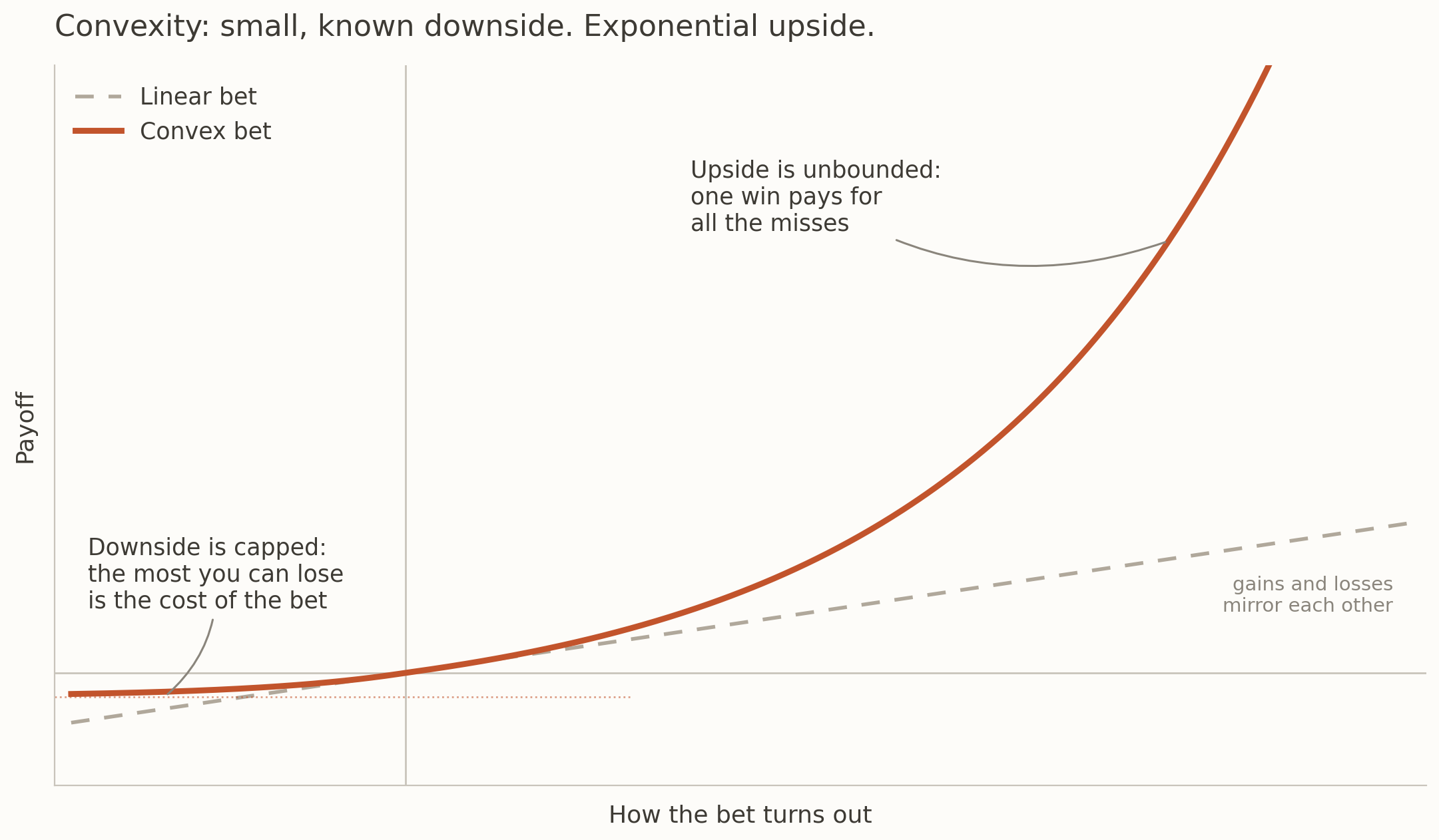
Venture capital is the cleanest example. Most VC investments fail. That’s not a flaw in the model, it is the model. A single failed investment won’t kill the fund. Even fifty won’t: a fund can lose $50M across fifty bets as long as one of them returns a billion. The losses are small and capped. The wins are enormous and make the losses feel like rounding errors.
Many product decisions have the same shape. Should we launch this product? Should we enter this new market? Should we implement this new feature? Each bet is risky and has a high chance of failure. But if you’re an established company, almost none of these bets can sink you. And if one or two succeed, the payoff can more than make up for everything else. Wanting certainty before committing is understandable, but certainty is an emperor without clothes. Only the market knows the truth.
Bob Iger talks about this in “The Ride of a Lifetime”: “No matter how much data you’ve been given, it’s still, ultimately, a risk, and the decision to take that risk or not comes down to one person’s instinct.” The analysis effort should match the ratio of risk to reward. And when a bet is convex, the ratio is so lopsided it feels like cheating: speed matters more than certainty.
But in large organizations, most hesitation isn’t fear of losing some money. It’s fear of failing in front of other people. A manager’s track record is a list of individual calls, and every visible miss makes them look bad. So the safest move is to analyze and de-risk more. I suspect this is a big part of why studies have shown that founder-led companies do better. Not because founders are smarter. Founders are willing to take more risk and have the courage to be disliked.
None of this is an argument against research. Talking to customers and studying the market is how you build the instinct that makes the call. But even the most thorough research can be wrong, and often will be. So research can’t be about exhausting every angle before you commit. It has to match the risk and reward. If you find a convex bet, make the call and move. The truth is in what happens next. Every month spent deliberating pushes that truth a month further out.
So here’s the habit worth building. Start with the shape of the bet: if it fails, can you absorb the loss, and if it wins, is the payoff orders of magnitude bigger? If it’s a two-way door, or better, a convex bet, decide fast. The market, the customers, and everyone else will forgive the small failures, but they’ll remember the major successes. Apple is remembered for the iMac, the iPod, the iPhone, and the iPad. Nobody remembers their numerous failed experiments in the graveyard.
The Convexity Model reminds me of how the music industry used to work (still works?).
And who can forget this triumph of Apple:
https://www.youtube.com/watch?v=6Q-BH8j06pM
Move fast where the blast radius is small and reversibility is high. Move slowly in areas where decisions create systemic dependencies, security exposures, or long-term lock-ins.